
Briceville
students during re-enactment
of the Battle of Tennessee Hollow
Stockade that started the
Coal Creek War
The free miners of Coal Creek tried a peaceful resolution to the conflict. They surrounded the convict miner stockade in Tennessee Hollow and forced the guards to surrender. They marched the guards and convicts to the town of Coal Creek (now Lake City) and put them on a train to Knoxville. They sent a telegram to Governor Buck Buchanan, explaining their actions and offered to meet to resolve the situation.
Governor Buchanan, accompanied by three companies of the Tennessee National Guard, met with the free miners in Coal Creek and Briceville. He tried to sell them on the virtues of having convicts work in the mines based on state economics. The free miners refuted his claims...the mass graves on the hillside above the KICC Mine in the Wye Community could not be justified based on economics.
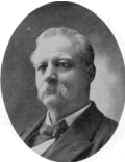
Governor Buck Buchanan
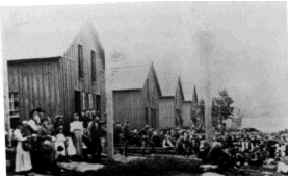
Tennessee Mining Company camp and
stockade in Briceville during a visit by
Governor Buchanan on July 16, 1891
(Note militiamen in center of photo)
Having failed in his mission, Governor Buchanan went back to Nashville, but left the militia. Before leaving, he gave his Commissioner of Labor, George Ford, the task of investigating the claims about the poor working conditions of the convict miners. Commissioner Ford inspected the mines and found that the Tennessee Mine in Tennessee Hollow was unfit, as follows:
“At one place a gang of seven or eight convicts were gathered in the passageway, with their lamps suspended from their caps, and one of them handling a can of powder, pouring it out of the can in a dangerously careless manner. It seemed as if a single false step might send the whole crowd to their maker instantly. In conclusion, this mine is found to be in worse condition than any mine in the State that has been inspected, of which we can find any record; and it is shameful to think that any class of men, whether free men or convicts, are compelled or allowed to work therein.”

Fieldstones marking the graves of
convict miners who died in the old
Knoxville Iron Company mine
After his inspection, the Commissioner had the convicts removed from the Tennessee Mine, but not KICC Mine No. 1. He offered a compromise to allow convicts to remain in mines where they had worked prior to the conflict, provided the mine met specified safety standards, but the miners refused.
After continued negotiations failed, the free miners decided to go to war. They again surrounded the stockades where the convicts were housed. The heavily outnumbered militia led by Colonel Granville Sevier, a distant relative of Tennessee’s first governor, surrendered. The free miners marched the troops, guards, and convicts from stockades in Tennessee Hollow and the Wye Community to the town of Coal Creek where they were put on the train to Knoxville.
Construction of Fort Anderson with its ability to fire its cannons into the town of Coal Creek and at the Miners Nest encampment on Walden Ridge forced a stand-off with the miners. The soldiers developed the habit of loading oyster cans filled with mud into their six-pound howitzers and firing them into Coal Creek where they would splatter on Main Street. This target practice served to remind residents that the guns of the fort could easily reduce their homes to rubble.

Photo of cannon on Militia Hill
during Coal Creek
War
The Tennessee Coal Mining Company in Briceville dismissed convict labor in February 1892, selling stock in the company to its miners.
On July 20, 1892, the miners celebrated the one year anniversary of the removal of convicts from Briceville at their “Convicts Gone Grand Picnic”. A platform was built using the lumber remaining from the destroyed stockade to serve as a dance floor for a “Grand Ball”. Prizes were given to winners of various games and races including “a pocket knife to the winner of the race for men weighing 200 pounds or more” and “a pair of fine slippers to the winner of the race for ladies weighing 200 pounds or more”.
As part of a coordinated attack on the convict labor system, the miners laid siege to Fort Anderson. The commander of the fort, Colonel Keller Anderson, met with businessmen and miners who were drinking buddies of his in Coal Creek to reach a settlement. He was captured by a group of miners who ordered him to surrender the fort or be hanged. His reply, “If you are determined to kill me, take me out and shoot me and tell my daughter I died game” made him an instant hero with the national media covering the war.
Meanwhile, a fresh contingent of militia from Knoxville under Major Daniel “Warhorse” Carpenter was dispatched to relieve the fort. The press proclaimed that “when the old warhorse gets to Coal Creek and gives the warhoop, the miners will hunt their hole”. Major Carpenter planned on leaving the railroad before arriving in Coal Creek, marching up the back side of Walden Ridge, and surprising the miners encamped at Miners Nest.

Briceville
students retracing the route
taken by the Tennessee Militia
prior to the Battle of Fatal Rock

Briceville
students on Walden Ridge
after their re-enactment of
the Battle of Fatal Rock
Unfortunately for his soldiers, they got lost and had to spend the night on the trail. At sun-up the next morning, they reached the top of Walden Ridge and were surprised by miners at Star Rock. At what became known as the Battle of Fatal Rock, they were forced to retreat back to Knoxville. Exhausted, the old warhorse had to be hauled back to the railroad in a farm wagon.
The governor finally sent in the entire State militia with Gatling guns and heavy artillery. They took hostages and threatened to level the town of Coal Creek unless Colonel Anderson was released. Being heavily outnumbered and outgunned, the miners were forced to release Colonel Anderson and surrender by October 1892.
Due to public sentiment for the free miners, the governor was not re-elected in November 1892. The new governor, Peter Turney, abolished the convict lease system in Tennessee. The remaining Southern states soon followed Tennessee’s lead and abolished the convict lease systems in their states. According to the program Chain Gangs on THE HISTORY CHANNEL: "The free miners of Coal Creek are credited with abolishing the convict lease system in the South, an institution that was worse than slavery".
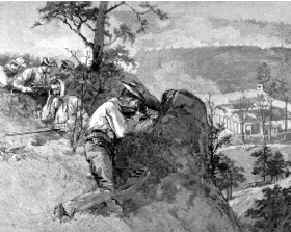
"Coal Creek miners attacking
the
Stockade" from Harper's Illustrated
Weekly, August 27, 1892
 Click
to view the scanned images from the real Harper's Illustrated magazine of
1892
Click
to view the scanned images from the real Harper's Illustrated magazine of
1892
Ironically, Governor Turney abolished the convict lease system because he found a more profitable alternative. In 1893, he enacted legislation to build Brushy Mountain Mine and Prison in nearby Morgan County. Coke ovens were built by the state to increase the value of the coal mined there and convicts were able to reduce their sentences based on how much coal they mined. Convicts with mining experience worked in the mine and the remaining convicts operated the coke ovens or farmed the land to feed the prisoners. From 1903 until 1917, the state realized a net profit of almost $1.7 million from Brushy Mountain.
Unlike the convict lease system, the state-operated mine provided financial incentive to sustain safe working conditions for the convict miners. The Brushy Mountain Mine continued to yield substantial profits for the state each year until it closed in 1938.
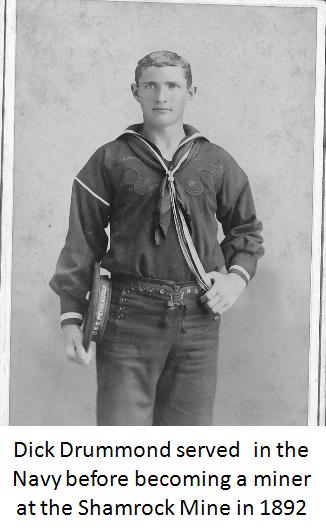
Troops remained at Fort Anderson until miner Dick Drummond was found hanging from a railroad bridge in Briceville on 10 August 1893. Sixteen officers and enlisted men of the Tennessee National Guard were arrested for the crime. The county jail in Clinton lacked the facilities to hold them, so they were transferred to the jail in Knoxville.
The ensuing trial lasted several weeks. Tennessee Governor Peter Turney feared that the spectacle would incite the miners to renew hostilities that had ended the previous summer when the town of Coal Creek was put under martial law. To diffuse the situation, he closed Fort Anderson and withdrew the Tennessee National Guard from Coal Creek.

The Coal Creek War officially ended on 17 May 2013, when a Treaty of Peace was signed during a dedication ceremony for the listing of Fort Anderson on the National Register of Historic Places.